The 5 Most Dangerous Cleaning Habits That Are Secretly Ruining Your Keycaps
You spent weeks picking out the perfect custom keycap set. You waited for the group buy, tracked the shipping, and meticulously snapped them onto your favorite switches. But the next time your board gets dusty, your standard cleaning routine might actually be a countdown to destroying them.
Because of Loss Aversion, most enthusiasts don’t realize that an aggressive cleaning habit can do more permanent damage than a spilled cup of coffee.
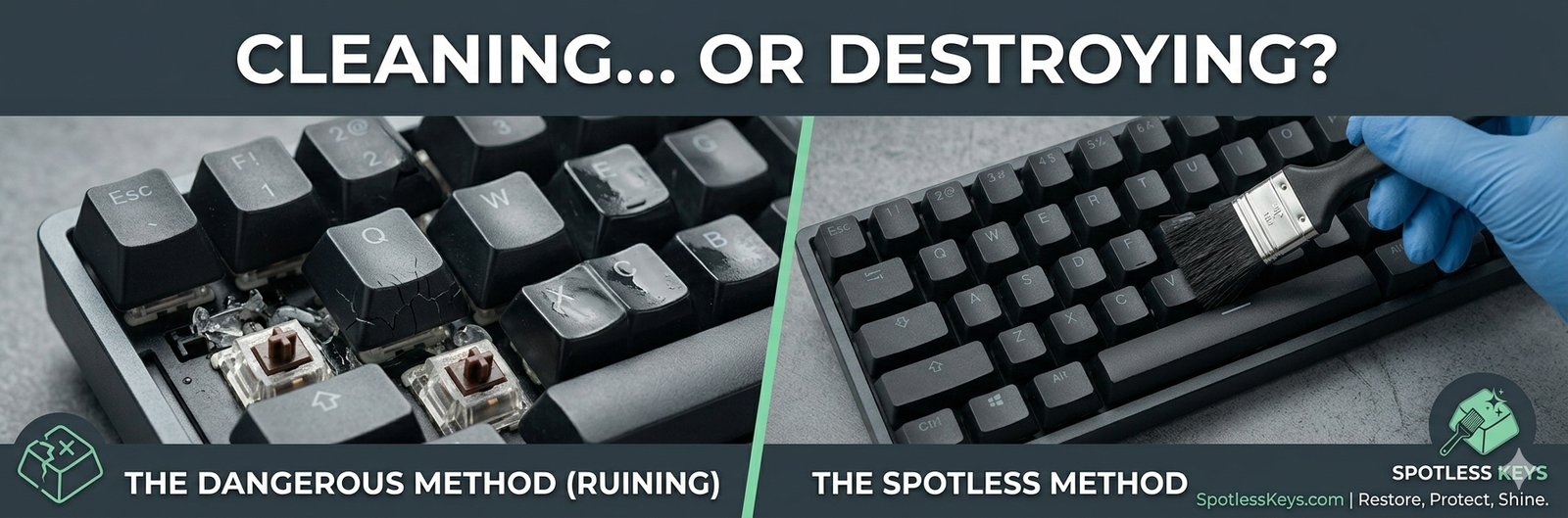
Here are the 5 most dangerous cleaning blunders that are ruining premium ABS and PBT keycaps right now—and how to fix them before it’s too late.
1. The Dish Soap Disaster (Stripping the Factory Texture)
It’s a common piece of advice on tech forums: “Just throw your keycaps in a bowl of warm water with a squirt of Dawn dish soap.”It’s a common piece of advice on tech forums: “Just throw your keycaps in a bowl of warm water with a squirt of Dawn dish soap.”
-
The Hidden Danger: Traditional dish soaps are formulated to cut through heavy cooking grease. Premium double-shot ABS keycaps rely on delicate surface tension to maintain their signature matte, slightly textured finish.
-
The Damage: Harsh degreasers strip away the micro-texture of the plastic, accelerating the permanent, slick “shine” that leaves your board looking oily and worn out.
-
The Safe Fix: Use a tiny drop of a mild, pH-neutral foaming hand soap or specialized electronics wash.
2. The Boiling Blunder (The Warped Stem Trap)
When keycaps get a layer of finger oils and skin cells built up, it’s tempting to use boiling water to thoroughly sanitize the plastic.
-
The Hidden Danger: ABS plastic begins to soften and warp at around 60°C to 70°C. Even premium PBT plastic, which has a higher heat resistance, can lose its structural integrity under extreme heat.
-
The Damage: Hot water permanently warps the internal cross-shaped stems. Even a microscopic shift in alignment means the keycap will either refuse to snap back onto your switch stem or sit visibly crooked in your layout.
- The Safe Fix: Keep your soak water under 40°C—if it’s too hot for your bare hands, it’s far too hot for your keycaps.
3. The Static Shock (Using Household Vacuums)
Seeing a thick layer of dust sitting on your switch plate makes you want to grab the household vacuum extension and suck it all away in five seconds.
-
The Hidden Danger: Standard household vacuums draw massive amounts of air through plastic nozzles, creating an immense buildup of Electrostatic Discharge (ESD).
-
The Damage: The moment that plastic nozzle brushes past a keycap and touches an exposed metal switch housing or plate screw, it discharges a spike of static electricity directly into your PCB, frying diodes or killing your microcontroller instantly.
- The Safe Fix: Use a dedicated electric duster with an anti-static grounding element or a simple hand-powered rubber air blower.
4. The Melting Slime Trap (Leaving Gel in the Housing)
Cleaning slime and gels are a satisfying way to lift dust from the tight spaces between keys. It feels like the ultimate quick fix.
-
The Hidden Danger: Cheap cleaning gels are incredibly sensitive to ambient room temperature and pressure.
-
The Damage: If you press the gel too firmly between rows, small fragments can break off and slide down into the open switch housings or stabilizer tracks. Over a few weeks, the gel degrades, melts into a sticky liquid inside the switch, and permanently ruins the internal metal leaf contacts.
- The Safe Fix: Stick to high-quality micro-bristle detailing brushes for the gaps between your keys.
5. The Isopropyl Alcohol Melt (Cracking ABS Plastic)
Isopropyl Alcohol (IPA) is a miracle cleaner for electronics, but spraying it directly onto a fully assembled keyboard is a critical mistake.
-
The Hidden Danger: While 99% IPA is safe for circuit boards and metallic plates, it causes a chemical reaction called Environmental Stress Cracking on molded ABS plastic.
-
The Damage: Spraying alcohol onto ABS keycaps causes the plastic to instantly dry out, become brittle, and develop micro-fractures along the legend seams or the bottom skirt edges.
- The Safe Fix: Only use alcohol on micro-cloths to gently wipe down PBT plastic or metal cases—never let it pool on ABS.
🛑 Stop Guessing. Use a Proven System.
Don’t let a weekend cleaning session turn into an expensive mistake. Protect your build with our Free Mechanical Keyboard Maintenance Checklist. It breaks down exactly what to do daily, monthly, and semi-annually to keep your board pristine without risking structural damage.