
Does Dust Actually Kill Your Switches? The Science of PCB Corrosion
Many enthusiasts think dust is just an aesthetic issue—a bit of “gamer gunk” that looks bad but doesn’t hurt performance. The reality is more microscopic and much more dangerous for your hardware.
If you want to understand why a clean keyboard is a functional keyboard, you have to look at the chemistry happening beneath your keycaps.
1. The “Conductive Bridge” Phenomenon
Dust is rarely just “dirt.” It’s a cocktail of dead skin cells, food particles, and microscopic mineral fibers. When humidity in the air hits these particles, they become hygroscopic (moisture-attracting).
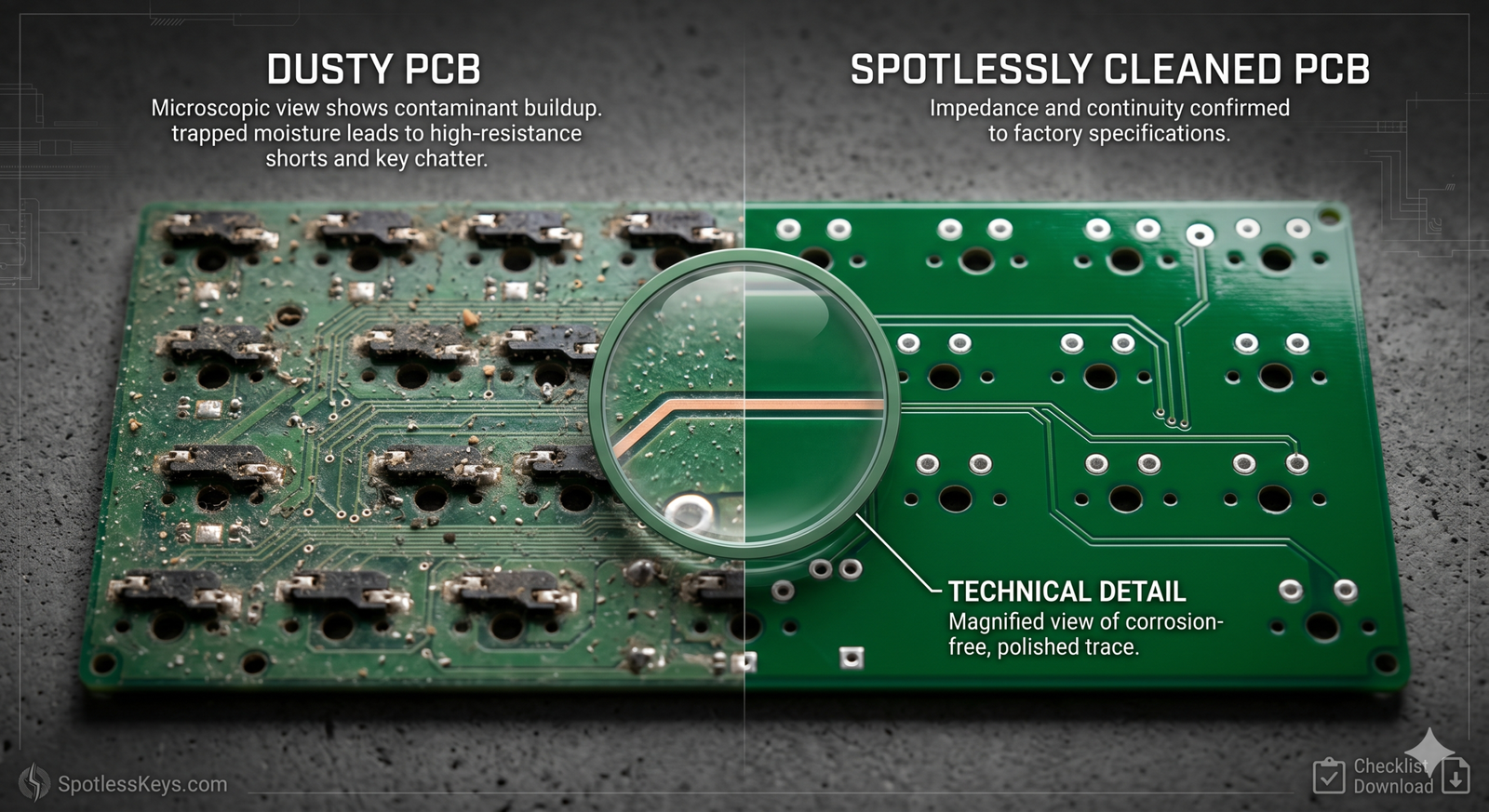
This creates a “conductive bridge” on your PCB. Even a tiny amount of moisture mixed with dust can allow electricity to flow where it shouldn’t, leading to:
-
Key Chatter: One press registering as two.
-
Ghosting: Keys activating on their own.
-
Total Failure: A short circuit that fries a diode or the controller.
2. Atmospheric Corrosion: The Silent Killer
Mechanical switches rely on metal leaf contacts (usually gold-plated copper) to register a keystroke.
-
The Problem: Dust particles can trap sulfur and nitrogen from the air.
-
The Result: This creates a corrosive micro-environment. Over time, it eats through the plating, causing oxidation. Once a switch leaf oxidizes, the metal becomes non-conductive, and the switch “dies.”
3. Friction and Stem Wear
Inside the switch housing, dust acts like sandpaper. Every time you press a dusty switch, those particles grind against the plastic stem and the housing. This destroys the factory lube and creates “scratchiness.” Once the plastic is physically abraded, no amount of cleaning can restore that original smooth feel.